ISO 14001 Consultants in Vietnam – ISO 14001:2026 Environmental Management System (EMS) Requirements
EMS Consulting Services by VINTECOM International
Overview of ISO 14001:2026 Environmental Management System
ISO 14001:2026 is the latest international standard for Environmental Management Systems (EMS), developed to help organizations systematically manage environmental responsibilities, improve environmental performance, strengthen ESG capability, and enhance sustainable supply chain management in the context of increasing global environmental and climate-related requirements.
Compared with previous versions, ISO 14001:2026 places stronger emphasis on:
- Climate Risk management;
- ESG and Environmental Governance;
- Green Supply Chain management;
- Carbon Management and GHG reduction;
- Environmental KPI and data management;
- Risk-based environmental management;
- sustainability and operational resilience.
ISO 14001:2026 helps organizations establish a systematic management framework to:
- identify environmental aspects and impacts;
- manage environmental risks and opportunities;
- improve operational environmental performance;
- strengthen compliance obligations;
- improve resource efficiency;
- reduce environmental incidents and operational disruptions;
- support long-term sustainable business growth.
The standard is applicable to organizations of all sizes and industries, especially:
- manufacturing industries;
- electronics;
- automotive;
- logistics;
- chemicals;
- energy;
- construction;
- food industries;
- FDI enterprises;
- and organizations participating in global supply chains.
Key Requirements of ISO 14001:2026
Environmental Policy
The environmental policy remains one of the core foundations of the EMS. Top management must demonstrate leadership and commitment toward environmental governance and continual improvement.
The environmental policy should include commitments to:
- environmental protection;
- continual improvement;
- pollution prevention;
- climate risk awareness;
- ESG integration;
- sustainable resource management;
- compliance with legal and other requirements.
ISO 14001:2026 strengthens leadership responsibility by requiring environmental management to be integrated into strategic business planning and organizational risk management.
Environmental Aspects and Impacts
Organizations must identify environmental aspects and evaluate associated environmental impacts resulting from:
- activities;
- products;
- services;
- outsourced processes;
- logistics;
- suppliers;
- and product life cycle considerations.
ISO 14001:2026 places stronger focus on:
- significant environmental risks;
- carbon-related impacts;
- climate-related operational impacts;
- and supply chain environmental considerations.
Environmental impacts may include:
- air emissions;
- wastewater;
- hazardous substances;
- waste generation;
- energy consumption;
- greenhouse gas emissions;
- resource depletion.
Compliance Obligations and Legal Requirements
Organizations must determine and maintain access to applicable:
- environmental laws and regulations;
- permits and licenses;
- ESG-related requirements;
- customer environmental requirements;
- Green Supply Chain requirements;
- carbon and climate-related obligations.
ISO 14001:2026 increases emphasis on evaluating the effectiveness of compliance activities rather than simply maintaining documentation.
Interested parties may include:
- regulatory authorities;
- customers;
- multinational corporations;
- FDI partners;
- investors;
- insurance organizations;
- local communities;
- and sustainability stakeholders.
Environmental Objectives and KPI Management
Organizations are required to establish measurable environmental objectives and KPI systems aligned with:
- organizational strategy;
- environmental policy;
- ESG expectations;
- sustainability targets;
- operational improvement goals.
ISO 14001:2026 encourages organizations to adopt data-driven environmental management approaches focusing on actual operational performance.
Typical objectives may include:
- energy reduction;
- carbon emission reduction;
- waste minimization;
- water conservation;
- environmental incident reduction;
- supplier environmental improvement.
Environmental Management Programs
Organizations must establish environmental management programs to achieve defined objectives and targets.
Programs should clearly define:
- responsibilities;
- resources;
- timelines;
- environmental controls;
- monitoring methods;
- performance indicators.
Well-designed EMS programs help organizations improve environmental effectiveness and sustainability performance.
Organizational Roles, Responsibilities, and Leadership
ISO 14001:2026 strengthens the role of leadership in EMS implementation.
Top management must ensure:
- integration of EMS into business processes;
- allocation of resources;
- environmental governance;
- continual improvement culture;
- risk-based decision making.
Organizations should assign competent personnel responsible for coordinating and maintaining the EMS.
Competence, Training, and Awareness
Organizations must ensure that employees affecting environmental performance are competent through:
- education;
- training;
- practical experience;
- awareness activities.
Personnel should understand:
- environmental policy;
- environmental risks;
- significant environmental aspects;
- emergency response requirements;
- ESG expectations;
- operational environmental controls.
ISO 14001:2026 also emphasizes awareness regarding climate risks and sustainability responsibilities.
Communication and Stakeholder Engagement
Organizations must establish processes for both internal and external communication regarding environmental matters.
Communication may involve:
- regulatory authorities;
- customers;
- supply chain partners;
- local communities;
- investors;
- ESG stakeholders.
Environmental communication should be transparent, controlled, and aligned with organizational sustainability objectives.
EMS Documentation and Documented Information
The EMS must include documented information necessary to ensure effective implementation and control of environmental processes.
Documented information may include:
- environmental policies;
- procedures;
- operational controls;
- environmental objectives;
- monitoring records;
- audit reports;
- emergency response plans;
- KPI reports.
ISO 14001:2026 focuses more on practical operational effectiveness rather than excessive documentation.
Operational Control
Organizations must establish operational controls for activities associated with significant environmental aspects.
Operational control may include:
- waste management;
- chemical handling;
- energy management;
- supplier environmental controls;
- logistics management;
- emissions control;
- emergency preparedness.
ISO 14001:2026 places stronger emphasis on operational effectiveness and environmental risk reduction.
Emergency Preparedness and Response
Organizations must establish procedures to:
- identify potential environmental emergencies;
- respond to incidents;
- minimize environmental impacts;
- periodically test emergency response capabilities.
Emergency preparedness should consider:
- chemical spills;
- fire incidents;
- environmental contamination;
- climate-related events;
- supply chain disruptions.
Monitoring, Measurement, Analysis, and Evaluation
Organizations must monitor and evaluate environmental performance using defined KPI and monitoring systems.
Monitoring may include:
- emissions monitoring;
- energy consumption;
- waste generation;
- environmental incidents;
- compliance evaluation;
- carbon and sustainability indicators.
Monitoring equipment should be calibrated and maintained appropriately.
ISO 14001:2026 strengthens requirements related to environmental data management and performance analysis.
Nonconformity, Corrective Action, and Continual Improvement
Organizations must establish processes for:
- identifying nonconformities;
- investigating root causes;
- implementing corrective actions;
- preventing recurrence;
- improving EMS effectiveness.
Risk-based corrective action and continual improvement remain key principles of ISO 14001:2026.
Environmental Records and Retention
Organizations must maintain appropriate records demonstrating EMS implementation and effectiveness.
Records may include:
- training records;
- audit reports;
- monitoring data;
- compliance evaluations;
- management review outputs;
- corrective action records.
Proper record control ensures traceability and evidence of EMS performance.
Internal Audit of EMS
Organizations must conduct periodic internal audits according to ISO 19011 guidelines to determine whether the EMS:
- conforms to ISO 14001:2026 requirements;
- is effectively implemented;
- is properly maintained;
- supports continual improvement.
ISO 14001:2026 encourages Risk-based Audit approaches focusing on operational effectiveness and environmental risks.
Management Review
Top management must periodically review the EMS to ensure:
- suitability;
- adequacy;
- effectiveness;
- alignment with business strategy;
- ESG objectives;
- climate and environmental risks;
- sustainability performance.
Management review supports continual improvement and long-term environmental governance effectiveness.
EMS Consulting Services by VINTECOM International
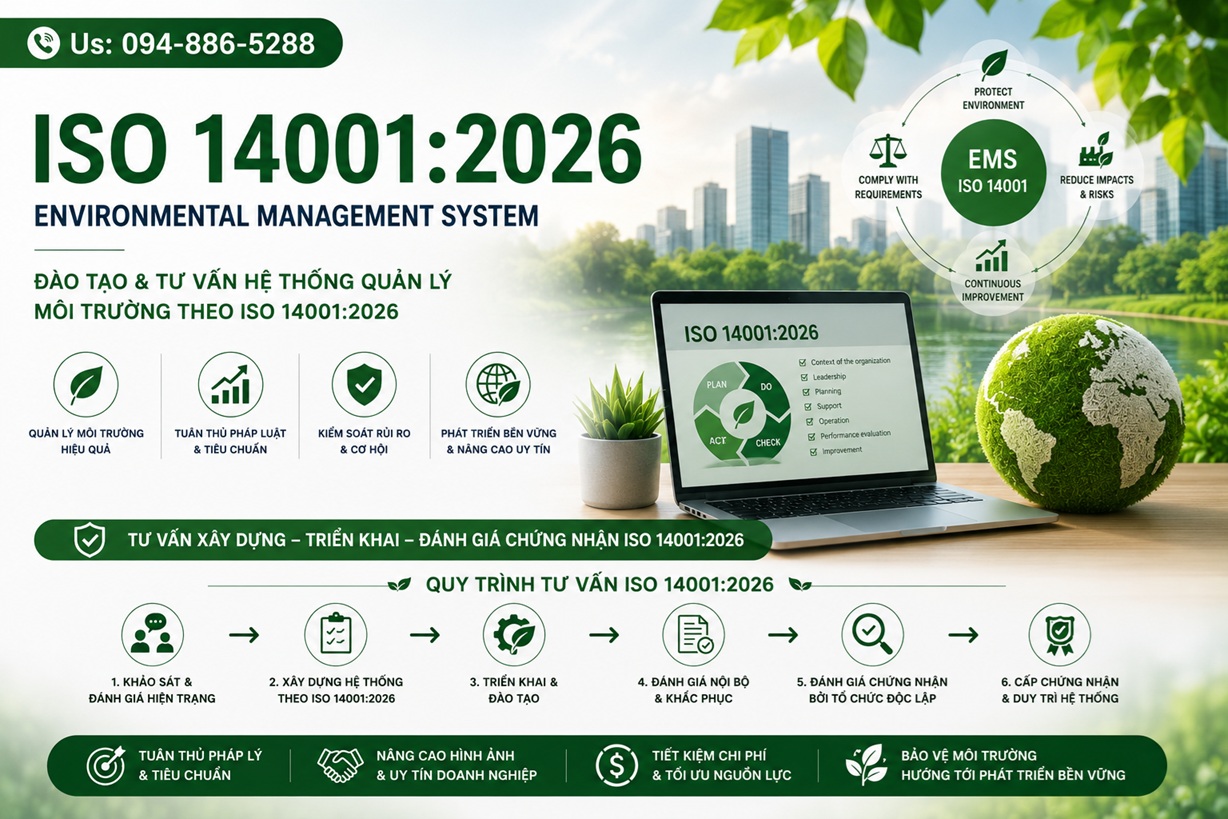
VINTECOM International provides professional EMS consulting services aligned with ISO 14001:2026 international requirements, including:
- ISO 14001:2026 awareness training;
- EMS implementation consulting;
- ESG integration support;
- Climate Risk assessment;
- Green Supply Chain management consulting;
- internal auditor training;
- Gap Assessment;
- internal audit support;
- certification preparation support.
VINTECOM International supports organizations in building practical, effective, and internationally aligned EMS systems suitable for modern global supply chain requirements and sustainable business development.
📶📶📶 Contact us today to register for ISO 14001:2026 Training, Consulting, and Certification Services.
Customers,
organizations and enterprises require Training course, Consulting or
Certification services of Enviroment Management System ISO 14001: 2026,
please click on "Registration - Quotation" or on the right toolbar below the PC screen to receive a quotation for training, consulting and certification services.
🎁🎁🎁 Enjoy 5% discount on training and consulting fees when registering online!
 📶📶📶 Further information, Please contact us as below:
☎ VINTECOM
International Office in Ha Noi City: 16th Floor - Green Stars City, 234
Pham Van Dong, Bac Tu Liem District, Ha Noi City. Hotline 094-886-5288/ (024) 730-588-58
☎ VINTECOM International Office in Ho Chi Minh City: GH3 - Glory Height Vinhome Grand Park - Thu Duc City, Ho Chi Minh City. Hotline 0938-083-998/ (028) 7300-7588
VINTECOM INTERNATIONAL MANAGEMENT CONSULTANCY COMPANY
Head Office: No. 5 Hoang Sam treet, Nghia Do, Cau Giay district, Ha noi City
HANOI VINTECOM INTERNATIONAL OFFICE
Address: 16th Floor - Green Stars City
234 Pham Van Dong Street, Phu Dien Ward, Hanoi City
Tel : (024) 730.588.58/ (024) 730.333.86
Hotline: 094 886 5288
Skype: kd.vintecom
Email : office-hn@vintecom.com.vn
Web : www.vintecom.com.vn
HCM VINTECOM INTERNATIONAL OFFICE
Address : Glory Heights - Vinhomes Grand Park
88 Phuoc Thien Street, Long Binh Ward, Ho Chi Minh City
Contact: Ms. Pham Thu Ha
Tel: (028) 7300 7588
Hotline: 0938 083 998
Email : office-hcm@vintecom.com.vn
Web : www.vintecom.com.vn